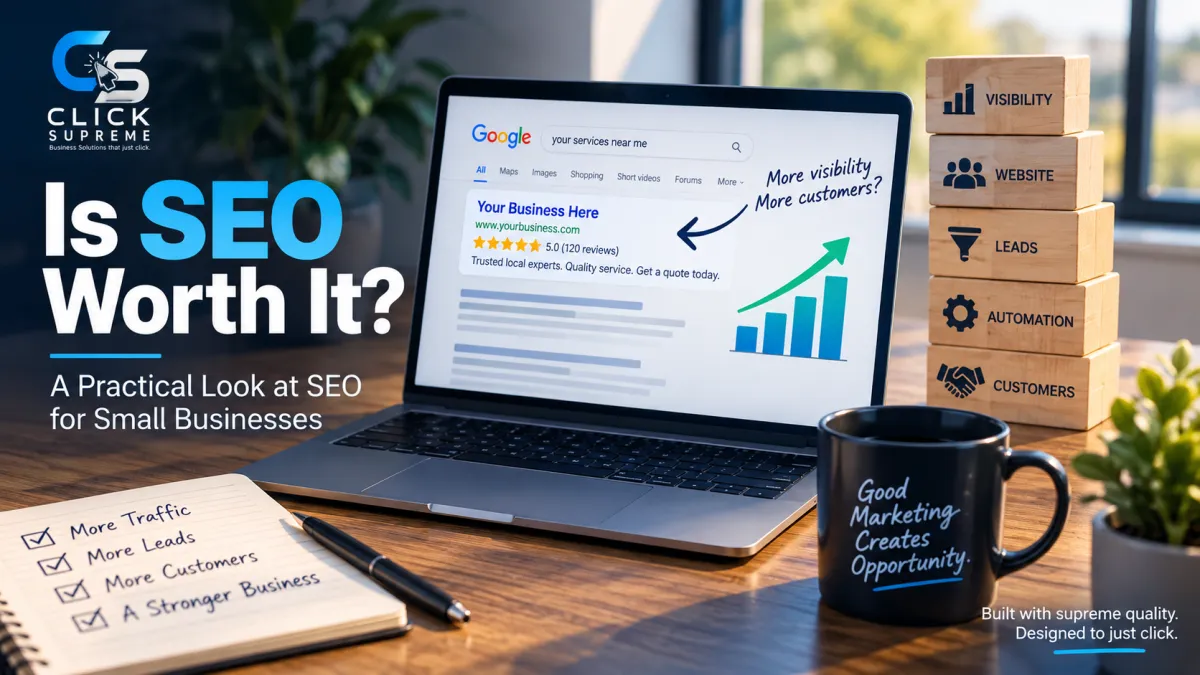
Is SEO Worth It? A Practical Look at SEO for Small Businesses
If you run a small business, you've probably heard that you need SEO. The harder question is whether SEO is actually worth the time and money it takes to do it well.
That's a reasonable question, especially when there are so many other ways to market a business. You could run Google Ads, advertise on social media, send emails, make cold calls, build referral relationships, or invest in improving your website. Unlike some of those strategies, SEO can also take time before it produces noticeable results.
So rather than simply saying every business needs SEO, it helps to look at what SEO is actually supposed to accomplish, how it fits into a larger marketing strategy, and the situations where investing in it makes the most sense.
What Does SEO Actually Do for a Business?
Search engine optimization, or SEO, is the process of improving your website and online presence so search engines can better understand what your business does and when your pages may be relevant to someone's search.
For a service business, that could mean appearing when someone searches for a service you provide, a problem you solve, a service in a particular location, or a question related to your industry.
SEO can involve keyword research, website structure, helpful content, internal linking, technical improvements, local SEO, backlinks, and other activities. All of those tactics serve a larger purpose: helping the right people discover your business when they're already searching for something relevant to what you offer.
That's an important distinction because the goal of SEO shouldn't simply be to "rank on Google." Rankings and traffic are useful measurements, but visibility only becomes valuable when it puts your business in front of the right potential customers.
So, Is SEO Worth It?
SEO can be worth the investment when your potential customers are already using search engines to research problems, compare solutions, and find businesses like yours.
Consider a local service business. If people regularly search Google for the exact services that business provides, there is already demand in the market. SEO isn't creating that demand. It's helping the business compete for visibility while those searches are taking place.
That also means search volume alone doesn't determine whether a keyword is valuable.
A website could attract thousands of visitors from broad informational searches and generate very little business. Another website might receive far less traffic but attract people specifically looking for the services it provides.
For most small businesses, the second type of traffic is considerably more useful.
This is why search intent matters so much. Before targeting a keyword, it helps to understand what the person behind that search is actually trying to accomplish. Someone researching a general topic may be much earlier in the buying process than someone searching for a specific service in their city.
Both searches can have value, but they serve different purposes.
SEO vs. Paid Advertising: What's the Difference?
One of the reasons SEO can be difficult to evaluate is that it works differently from paid advertising.
With pay-per-click advertising, a business can potentially begin generating website traffic shortly after launching a campaign. You're essentially paying for access to existing demand, and when the advertising budget stops, the flow of paid traffic generally stops with it.
SEO takes a different approach.
Instead of paying directly for each click, you're investing in assets you own—your website, service pages, helpful articles, local presence, and overall authority. Those assets can take time to gain visibility, but a useful page can potentially continue attracting visitors long after it was originally published.
That doesn't mean SEO is better than PPC, or that PPC is better than SEO. They solve different problems.
A business that needs leads immediately may put more emphasis on paid advertising or direct outreach. At the same time, it may invest in SEO to gradually build organic visibility over a longer period.
In many cases, the two strategies can work together rather than compete against one another.
When Does SEO Make the Most Sense?
SEO becomes particularly interesting when there is established search demand for what your business sells.
Suppose you operate a service business and potential customers regularly turn to Google when they need the service you provide. If an individual customer is also worth a meaningful amount to the business, attracting even a relatively small number of qualified searches can potentially matter.
The opportunity becomes stronger when your business serves a defined geographic area or niche, you can create useful content around the questions customers are already asking, and your website plays an important role in turning interest into inquiries.
However, there's another side to the equation.
Getting someone to your website is only the beginning.
If visitors arrive and can't quickly understand what you do, why they should consider your business, or what they should do next, additional traffic may not solve the underlying problem.
This is where SEO and lead generation websites begin to overlap.
SEO helps your business get discovered. Your website has to do something useful with that attention.
A well-designed lead generation website should give visitors a clear path from learning about your business to taking the next step, whether that's making a call, requesting information, scheduling an appointment, or completing an assessment.
When Might SEO Not Be the Best Priority?
SEO isn't automatically the right investment for every business, particularly when there are more immediate problems that need to be solved.
If very few people search for what you offer, your target customers are easier to reach through direct outreach, or you need new opportunities immediately, another marketing channel may deserve more attention in the short term.
The same is true when a business already receives leads but struggles to manage them.
Imagine spending months increasing organic traffic only to discover that inquiries aren't being answered quickly, estimates aren't being followed up on, or leads are getting lost between different inboxes and spreadsheets.
In that situation, generating more traffic might not be the highest priority. Improving the process behind the traffic could have a greater impact.
This is why we tend to look at SEO as one piece of a larger business growth system rather than a standalone solution.
SEO Is About More Than Getting More Traffic
It's easy to look at website traffic as the primary measurement of SEO success, but more traffic isn't always better traffic.
Imagine one website receives 5,000 visitors per month, but most of those visitors have little connection to what the business sells. Another receives 500 visitors, but a meaningful portion of them are researching the exact problems and services the business addresses.
The smaller audience may ultimately be far more valuable.
For that reason, SEO performance should be viewed through several measurements. Search impressions and rankings can help show whether visibility is improving. Organic clicks can show whether people are actually visiting the site. From there, calls, form submissions, appointments, qualified leads, and customers provide a better picture of whether that visibility is contributing to the business.
Traffic is part of the story. It isn't the entire story.
How Long Does SEO Take to Work?
SEO is generally better viewed as a long-term process than an immediate lead generation strategy.
A new page or article may be discovered by search engines relatively quickly, but meaningful visibility—especially for competitive searches—can take considerably longer.
The timeline depends on the market, competition, existing website authority, content quality, technical foundation, backlinks, and the keywords being targeted.
This is also why early SEO results can sometimes be misleading.
A website may begin receiving more impressions before it receives significantly more clicks. Individual pages may start appearing for new searches before they reach prominent positions. Over time, those early indicators can help show whether the site is moving in the right direction, even though they don't guarantee future traffic or customers.
The important point is that SEO usually needs enough time and enough data to evaluate it fairly.
Is SEO Worth It for a Small Business?
For a small business, this question often comes down to opportunity cost.
Every dollar and every hour spent on SEO is a resource that can't be spent somewhere else. If a business is starting from zero and needs customers immediately, cold outreach, referrals, networking, or paid advertising may provide faster feedback.
SEO serves a different purpose.
When you create a genuinely useful service page or article, you're building an asset on your own website. Over time, those individual assets can begin forming a library of information around the services you provide and the problems your customers are trying to solve.
Instead of expecting one homepage to rank for everything, your website gradually develops more entry points for relevant searches.
This is where a long-term content strategy becomes particularly useful. One article may answer an introductory question. Another may explain a service. Another might address a common concern or comparison. Together, those pages can help search engines—and potential customers—better understand what your business is about.
What About Local SEO?
For service businesses operating in specific geographic areas, SEO isn't limited to traditional website rankings.
Potential customers may also encounter your Google Business Profile, customer reviews, service information, location pages, and other local search results while researching their options.
That makes local visibility closely connected to reputation.
A business might appear in search results, but potential customers may still evaluate its reviews before deciding whether to visit the website or make contact. In that sense, SEO and reputation management aren't completely separate activities. Both influence what someone discovers while researching the business.
The same principle applies within individual industries. Our guide to SEO for Hunting Outfitters, for example, looks at how these fundamentals can be applied within a specific niche rather than approaching SEO as a one-size-fits-all strategy.
SEO Works Better When the Rest of the System Works
This is probably the most important part of deciding whether SEO is worth it.
SEO can help generate visibility, but visibility is only the beginning of the customer journey.
Your website needs to turn that attention into an inquiry. Your CRM needs to keep that inquiry organized. Follow-up and automation can help make sure legitimate opportunities don't disappear. Reputation management can help reinforce trust while potential customers evaluate your business.
In other words, these aren't six completely separate marketing activities.
They're connected.
SEO helps people find you.
Your website gives them somewhere to go.
Your offer gives them a reason to take action.
Your CRM helps organize the opportunity.
Automation helps maintain follow-up.
Your reputation helps establish credibility along the way.
When those pieces work together, increasing visibility becomes much more meaningful.
How Do You Decide if SEO Is Worth It for Your Business?
Before investing heavily in SEO, start by looking at the business rather than the marketing tactic.
Are people actively searching for the services you provide? What words are they using? What businesses currently appear in those results? How competitive is the market? What would a qualified lead or new customer be worth?
Then look beyond the search results.
If someone finds your business today, is your website ready for them? Is there a clear next step? If they submit a form or make a call, do you have a reliable process for responding and following up?
Those questions help put SEO in the proper context.
The question isn't simply whether SEO works.
The better question is whether increasing organic search visibility solves an important problem for your business right now.
The Bottom Line: Is SEO Really Worth It?
For many small businesses, SEO can become a valuable long-term marketing asset—but only when it is connected to a real business opportunity.
If potential customers are searching for what you offer, your website is capable of turning those visitors into inquiries, and you have a process for managing those opportunities, improving organic visibility can make a lot of sense.
But SEO doesn't have to be the first answer to every marketing problem.
Sometimes a business needs more visibility. Sometimes it needs a better website. Sometimes leads are already coming in and the bigger problem is follow-up. In other cases, paid advertising or direct outreach may be a better way to generate opportunities right now.
The goal isn't to invest in SEO simply because businesses are told they should.
The goal is to understand where your biggest opportunity is and build the right system around it.
Not Sure Where Your Biggest Growth Opportunity Is?
Before deciding whether you need more SEO, a better website, stronger follow-up, or something else entirely, it helps to understand where the gaps are.
The Click Supreme Business Growth Assessment looks across your website, lead generation, SEO, CRM, automation, and online reputation to help identify areas that may be holding your business back.
