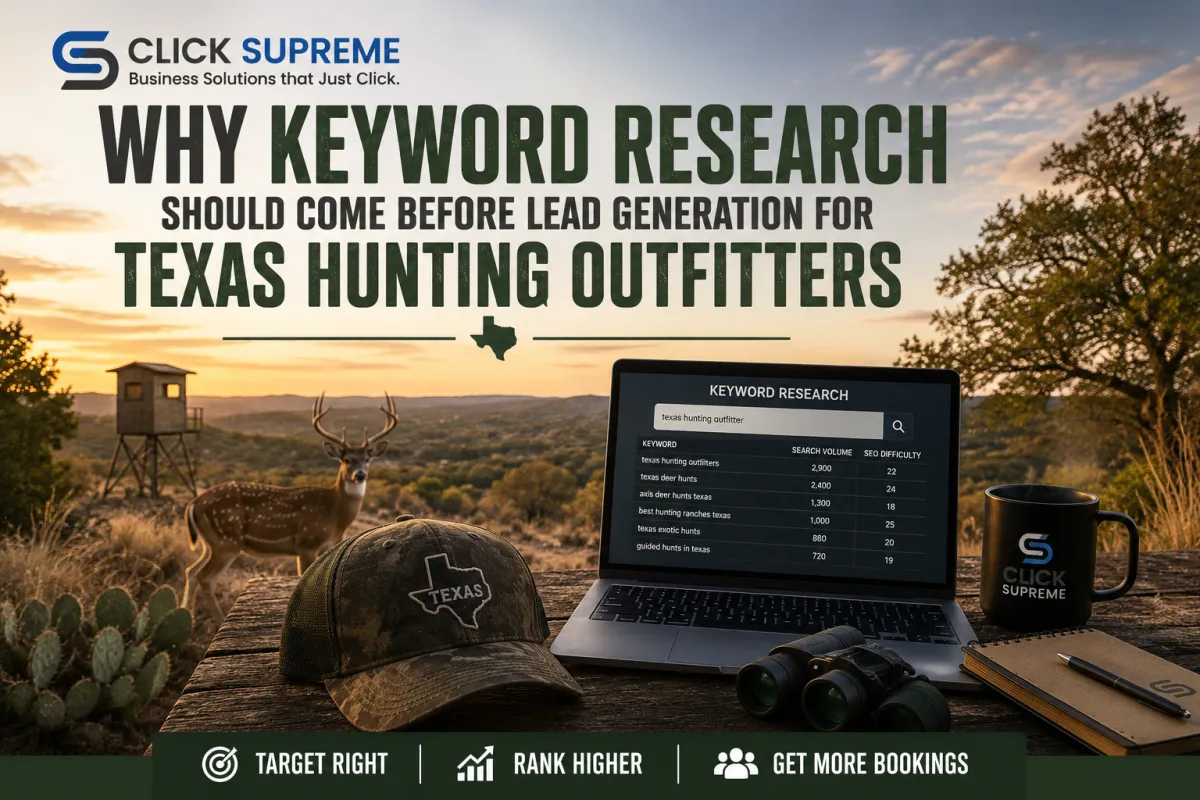
Why Keyword Research Should Come Before Lead Generation for Texas Hunting Outfitters
Getting more leads sounds like the obvious goal for any hunting outfitter looking to grow.
More inquiries. More conversations. More booked hunts.
But before spending money on ads, rebuilding a website, creating landing pages, or launching a new lead generation campaign, there’s an important question worth answering first:
What are hunters actually searching for?
That’s where keyword research comes in.
For Texas hunting outfitters, understanding how potential customers search online can help determine which hunts to promote, which pages to build, what content to create, and where the best opportunities may be hiding.
In other words, lead generation shouldn’t start with generating leads. It should start with understanding demand.
Hunters May Not Search the Way You Think They Do
One of the easiest mistakes to make in marketing is assuming customers use the same language you use.
An outfitter may describe a hunt by the species, ranch, package, season, or hunting method. A potential customer sitting hundreds of miles away may search for something completely different.
They might search by:
• Species
• Location
• Type of hunt
• Trophy opportunity
• Guided vs. unguided
• Time of year
• Price or package
• A combination of several of these
Even small differences in wording can represent very different levels of search demand and buyer intent.
For example, someone searching for “Hunting Outfitters South Texas” is telling Google quite a bit. They aren’t simply researching hunting. They’re looking for an outfitter in a specific part of Texas.
That distinction matters.
Keyword Research Helps Identify Where Demand Already Exists
Good marketing doesn’t always mean creating demand from scratch.
Sometimes the better opportunity is identifying demand that already exists and positioning your business in front of it.
Keyword research gives us a way to investigate that.
Instead of guessing which services deserve the most attention, we can look at the searches hunters are already making.
For a Texas outfitter, that could mean researching searches related to whitetail hunts, axis deer, aoudad, blackbuck, turkey, hogs, or other hunting opportunities—and then looking deeper at the locations and language hunters use alongside them.
The goal isn’t simply to find the keyword with the biggest number next to it.
The goal is to find searches that make sense for your actual business.
A smaller keyword from someone actively looking to book the exact hunt you offer can be far more valuable than a larger keyword with little connection to your services.
Strategy Should Come Before Traffic
This is where keyword research becomes more than an SEO exercise.
Imagine building a beautiful new landing page and then discovering that the terminology used throughout the page isn’t how your potential customers search.
Or paying to send traffic to a broad page when research shows hunters are searching specifically for individual species and locations.
You can fix those problems later.
But why not investigate them first?
At Click Supreme, we believe the order should be:
Strategy & Keyword Research → Lead Generation → Follow-Up
Each step makes the next one stronger.
First, understand the opportunity.
Then build the right pages and lead-generation strategy around it.
Finally, have a system in place to follow up with the people who raise their hand.
Keyword Research Can Help Shape Your Website
This is also why keyword research should happen before deciding what pages a hunting outfitter’s website needs.
Suppose an outfitter offers several different hunts.
Rather than putting every hunt onto one general page, keyword research may reveal opportunities to create dedicated pages around specific services or searches.
That could eventually mean pages focused on particular species, geographic areas, or hunting experiences.
Those pages aren’t created simply because someone said, “We need more content.”
They have a purpose.
Each one can be built around a specific type of hunter, a specific search, and a specific next step.
Over time, that creates a website designed around how customers actually look for what you sell.
More Traffic Isn’t Always the Goal
It’s easy to become focused on website traffic.
But an outfitter doesn’t need thousands of random visitors.
You need the right potential hunters finding the right information at the right time.
If ten highly qualified prospects find a page about a hunt they’re actively considering, those visitors may be more valuable than hundreds of people who land on a generic article and leave.
That’s why we don’t look at search volume alone.
We also want to understand intent.
What is the person behind the search likely trying to accomplish?
Are they gathering information?
Comparing outfitters?
Researching a particular species?
Or are they getting close to choosing where they’re going to hunt?
Those differences should influence the pages and content we create.
Then Lead Generation Makes More Sense
Once we understand what potential customers are searching for, lead generation becomes much more focused.
Now we can make better decisions about:
• What pages to build
• What hunts to feature
• What questions to answer
• What content to publish
• Where to send traffic
• What action we want visitors to take
And once someone does inquire, the next piece becomes just as important:
Follow-up.
Because generating an inquiry doesn’t accomplish much if that prospect gets forgotten in an inbox or never hears from the business again.
That’s why we view growth as a connected system rather than a collection of unrelated marketing tactics.
Start With the Right Questions
Before asking, “How do we get more leads?”, it may be worth asking a few questions first.
What are our ideal customers searching for?
Which of our hunts have meaningful search opportunities?
Where are we already showing up?
Where are competitors showing up instead?
Are we sending visitors to pages that actually match what they searched for?
And once someone contacts us, what happens next?
Those answers can give you a much clearer picture of where the real opportunities are.
See Where Your Outfitter Stands
Before investing more time or money into marketing, it helps to understand where your biggest opportunities may be.
The 2026 Outfitter Growth Assessment is a short assessment designed to help identify where your business currently stands across online visibility, lead generation, and follow-up.
