
Lead Automation for Hunting Outfitters: How to Follow Up With More Hunting Leads
Generating hunting leads is only part of the challenge for an outfitter.
The bigger question is:
What happens after someone reaches out?
A hunter may submit a form, send a Facebook message, call about an available hunt, or ask for pricing—and still not be ready to book immediately.
That doesn't necessarily mean the lead is lost.
They may need to check their schedule. They may be coordinating with a hunting partner or group. They may need time to think about the cost. Or they simply may not be ready to make a decision during the first conversation.
This is where lead automation can make a major difference for hunting outfitters.
A good follow-up system helps you stay in contact with interested hunters without requiring you to manually remember every conversation, email, phone call, and follow-up.
What Is Lead Automation?
Lead automation is the process of using a system to automatically organize, track, and follow up with prospective customers.
For a hunting outfitter, that could mean a hunter visits your website and asks about an Axis deer hunt.
Instead of their information sitting in an email inbox—or worse, getting forgotten—the lead can automatically enter a follow-up process.
For example:
Hunter submits an inquiry → Lead enters your system → You receive a notification → Hunter receives a response → Follow-up is scheduled → Lead remains organized until they book or decline
The goal isn't to remove the personal relationship between the outfitter and the hunter.
It's to make sure opportunities don't disappear simply because nobody remembered to follow up.
Why Lead Follow-Up Matters for Hunting Outfitters
High-value hunts aren't impulse purchases.
Someone considering a $5,000, $7,500, or $10,000+ hunting package may need multiple conversations before making a decision.
Think about the questions a prospective hunter may have:
What dates are available?
What is included in the hunt?
Is lodging included?
Can they bring another hunter?
What size animals can they expect?
How much is the deposit?
What happens if they need to reschedule?
How do they get to the ranch?
What licenses or permits do they need?
That creates a longer buying process than many traditional service businesses.
And the longer the buying process becomes, the more important follow-up becomes.
The Problem With Relying Only on Phone Calls
Phone calls are extremely valuable in the outfitting business.
A conversation gives an outfitter an opportunity to answer questions, establish trust, explain the hunt, and determine whether the hunter is a good fit.
But there's one problem.
Not every phone call results in an immediate booking.
Imagine someone sees your hunt advertised on Facebook and calls.
They ask about your available dates and pricing.
You have a good conversation.
Before hanging up, they say:
"Sounds good. Let me talk to my buddy and I'll get back with you."
What happens next?
If you don't have a follow-up system, you're relying on one of two things:
The hunter remembers to call you back.
You remember to follow up with the hunter.
Neither is particularly reliable.
A lead automation system gives you another option.
The hunter can be added to your pipeline and a follow-up task or message can be scheduled automatically.
Now the opportunity isn't dependent entirely on memory.
What an Automated Outfitter Follow-Up System Could Look Like
Lead automation doesn't need to be complicated.
In fact, a simple system is often better.
An Outfitter lead automation system can look something like this:
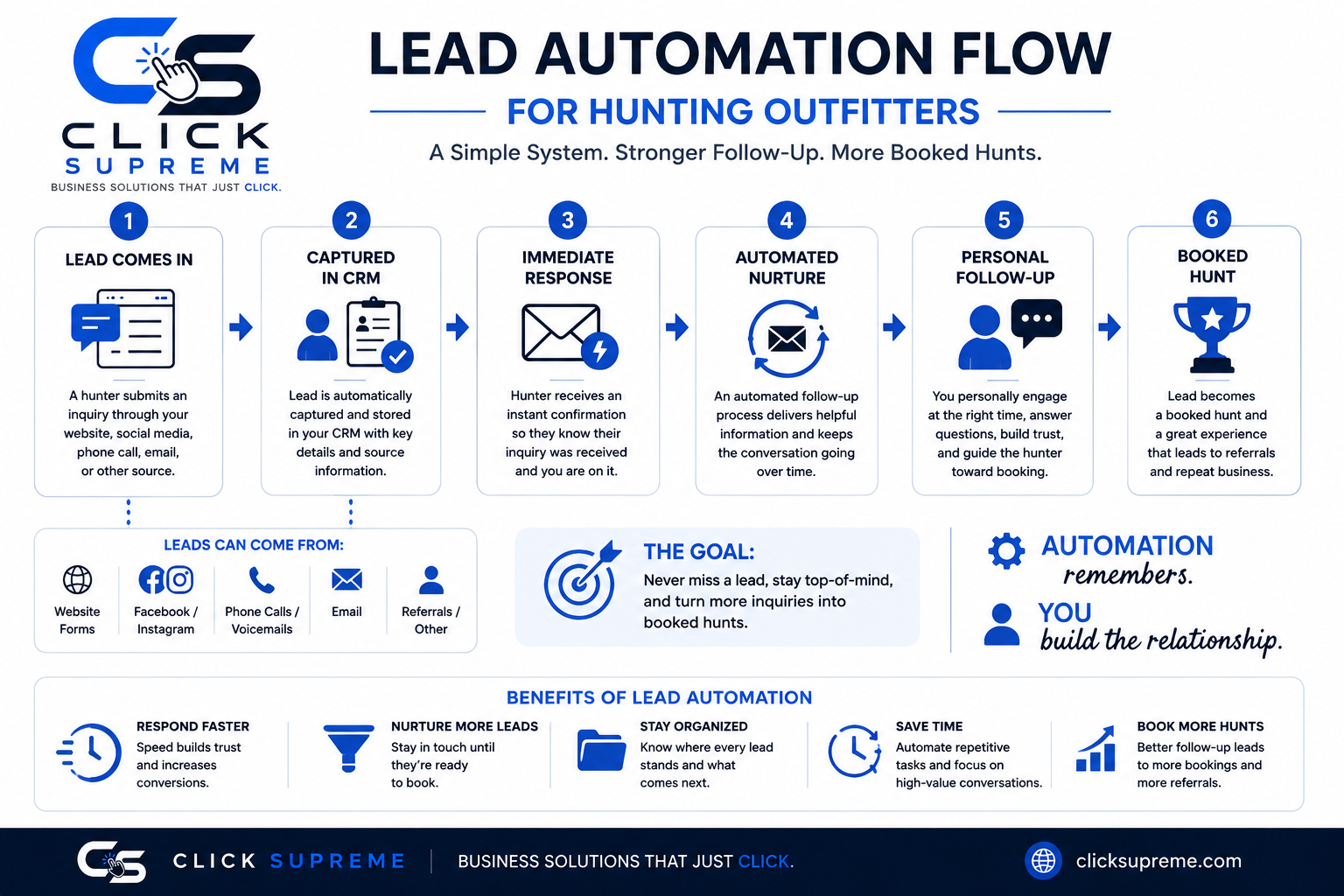
The goal isn't to automate the relationship. The goal is to make sure every lead has a next step while you focus on the conversations that turn inquiries into booked hunts.
Step 1: Capture the Lead
The first step is making sure inquiries have somewhere to go.
Leads might originate from:
Your website
A landing page
Facebook
Instagram
Google
Paid advertising
Email
Referrals
Phone calls
The important part is getting those opportunities into one organized system.
Step 2: Record What the Hunter Is Interested In
Not every hunting lead is the same.
Someone interested in an Axis deer hunt shouldn't necessarily receive the same follow-up as someone looking for a whitetail, aoudad, blackbuck, or dove hunt.
Basic information can make follow-up much more relevant.
For example:
Species: Axis Deer
Desired Dates: October–December
Number of Hunters: 2
Budget: $5,000–$7,500
Lead Source: Facebook
Now you're not simply following up with "a lead."
You're following up with a hunter who has already told you what they're looking for.
Step 3: Respond Quickly
Speed matters when someone is actively researching a hunt.
A prospective hunter may contact several outfitters while comparing availability, pricing, locations, and packages.
An automated system can immediately confirm that their inquiry was received.
That doesn't mean automation should pretend to be a personal conversation.
A simple confirmation works:
"Thanks for reaching out. We received your inquiry about an Axis hunt and will be in touch shortly."
Then the outfitter can personally continue the conversation.
Automation handles the repetitive part.
The outfitter handles the relationship.
Step 4: Create a Follow-Up Process
This is where automation becomes especially useful.
Suppose you talk to a prospective hunter on Monday.
They're interested, but they aren't ready to put down a deposit.
Instead of relying on memory, the lead can automatically move into a follow-up sequence.
That might include:
Day 0: Initial inquiry
Day 1: Personal response or phone call
Day 3: Follow-up
Day 7: Additional information about the hunt
Day 14: Availability reminder
Day 30: Longer-term follow-up
The exact timing will depend on the outfitter, species, season, and type of hunt.
The important part is having a process.
Step 5: Know When to Stop the Automation
Good automation should also know when not to send something.
If a hunter books, the sales follow-up should stop.
If they reply, the conversation may need to move back to the outfitter.
If they tell you they're no longer interested, they shouldn't continue receiving booking reminders.
Automation works best when it supports real conversations rather than replacing them.
Organize Hunting Leads With a Simple Pipeline
Another benefit of lead automation is visibility.
Instead of trying to remember where every prospective hunter stands, leads can be organized into stages.
A simple outfitter pipeline might look like:
New Lead → Contacted → Interested → Follow-Up → Deposit Requested → Hunt Booked → Not Ready
At a glance, you can see which hunters need attention.
This becomes increasingly important as lead volume grows.
Five inquiries may be easy to remember.
Fifty aren't.
Lead Automation Doesn't Mean Robotic Marketing
One of the biggest misconceptions about automation is that everything needs to become automated.
It doesn't.
For hunting outfitters, the personal relationship can be one of the biggest advantages you have.
Hunters may want to know who they'll be hunting with. They may want to hear about the ranch, accommodations, guides, animals, previous hunts, and what they can realistically expect.
Those conversations should remain personal.
The purpose of automation is to handle the repetitive administrative work surrounding those conversations.
Think of it this way:
Automation remembers. You build the relationship.
Start With the Leads You Already Have
You don't necessarily need more leads before improving your follow-up process.
Start by looking at what happens to the inquiries you're already receiving.
Ask yourself:
Where are our leads coming from?
Where do we record them?
How quickly do we respond?
What happens when someone doesn't book immediately?
Do we have a scheduled follow-up process?
Can we tell which leads are still interested?
Do we know how many inquiries eventually become booked hunts?
Those questions can uncover opportunities before spending another dollar generating traffic.
More Leads Aren't Always the Answer
It's easy to assume that booking more hunts requires generating more leads.
Sometimes it does.
But sometimes the bigger opportunity is improving what happens after the lead arrives.
If ten hunters inquire and only one books, generating another ten inquiries may help.
But improving the process used to follow up with the original ten may be just as valuable.
That's why lead generation and lead automation should work together.
Marketing creates the opportunity.
Follow-up helps turn that opportunity into a booked hunt.
Building a Better System for Your Outfitting Business
The best lead automation system isn't necessarily the most complicated one.
It's the one your outfitting business will actually use.
Start simple:
Capture the inquiry.
Organize the lead.
Respond quickly.
Schedule the next step.
Continue following up until there's a clear outcome.
Once that process is working, additional automation can be added where it makes sense.
The objective isn't automation for the sake of automation.
The objective is simple:
Make sure good hunting leads don't fall through the cracks.
How Strong Is Your Current Follow-Up Process?
If you're generating inquiries but aren't sure how well your website, lead generation, and follow-up process are working together, our Outfitter Growth Assessment can help identify potential gaps.
The assessment looks at key areas of your current marketing and lead process to help determine where opportunities may be getting missed.
Take the Outfitter Growth Assessment →
Because sometimes the next booked hunt doesn't require another lead.
It requires better follow-up with the leads you already have.
