Pay-Per-Click Advertising for Hunting Outfitters: The Basics
Getting more hunters to discover your outfitting business online doesn't always have to mean waiting months for your website to climb the search rankings.
Pay-per-click advertising, commonly called PPC, gives hunting outfitters another way to get in front of potential clients who are actively searching for the types of hunts they offer.
When used correctly, PPC can put your outfitting business in front of the right hunter at the right time — whether they're searching for a trophy whitetail hunt, an exotic hunt in Texas, or another high-value hunting experience.
But simply running an ad isn't enough.
The ad, keyword, website, and follow-up process all need to work together.
Here's a basic look at how PPC advertising works for hunting outfitters and where it can fit into your overall marketing strategy.
What Is Pay-Per-Click Advertising?
Pay-per-click advertising is a form of online advertising where you typically pay when someone clicks your ad.
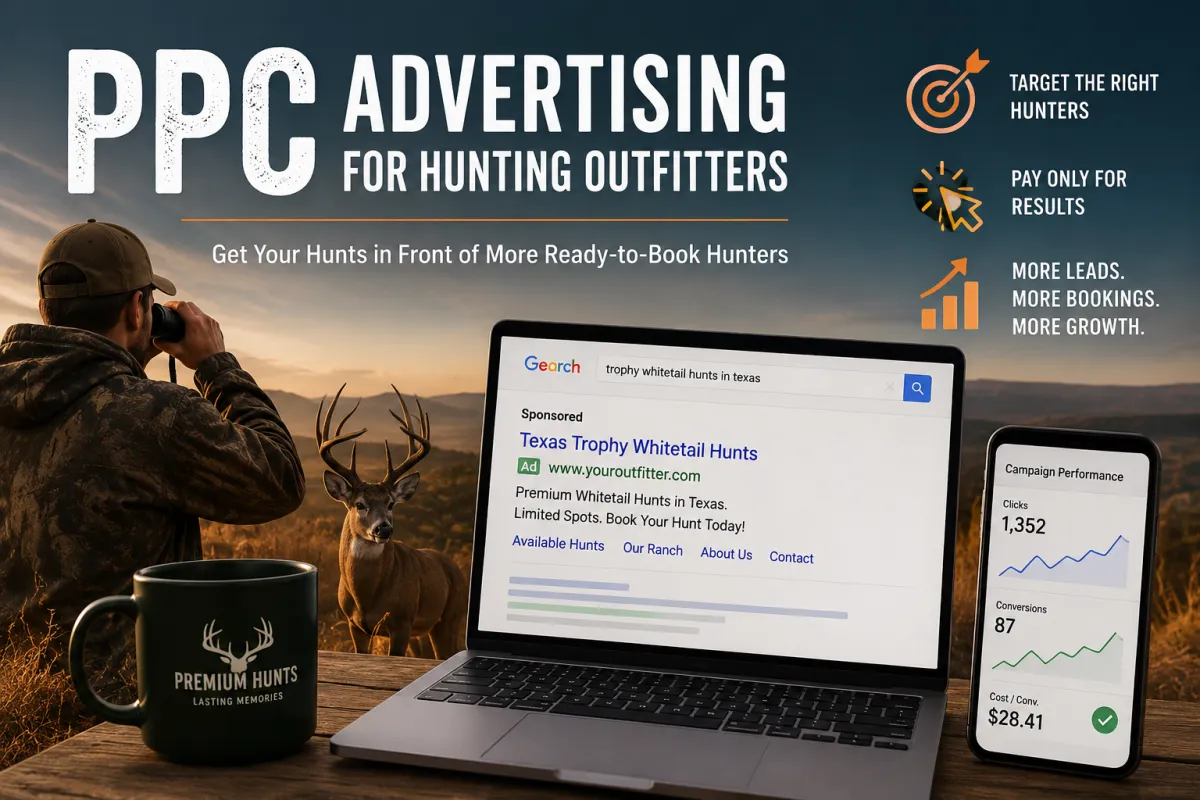
One of the most familiar examples is a sponsored result appearing near the top of a Google search.
Imagine a hunter searches:
"trophy whitetail hunts in Texas"
Several outfitting businesses may appear organically in the search results, but paid advertisements can appear prominently on the page as well.
An outfitter using PPC can potentially place their offer in front of that hunter immediately instead of relying entirely on organic search rankings.
That's one of the biggest differences between PPC and SEO.
SEO is designed to build visibility over time. PPC allows you to pay for targeted visibility now.
Both can play an important role in a long-term marketing strategy.
Why PPC Can Make Sense for Hunting Outfitters
Not every website visitor has the same value.
Someone searching for general information about deer hunting may simply be researching.
Someone searching for:
Trophy whitetail hunts in Texas
Guided whitetail hunts
Texas exotic hunting packages
Corporate hunting trips
Trophy deer hunting outfitters
may be much closer to actually booking a hunt.
This is where PPC gets interesting.
Rather than advertising to everyone interested in hunting, search advertising can help you target people based on what they're actively looking for.
For outfitters selling hunts worth several thousand dollars, attracting even a relatively small number of qualified prospects can potentially make a campaign worthwhile.
The goal isn't necessarily to generate the most traffic.
The goal is to generate the right traffic.
Step 1: Start With Search Intent
Before running ads, you need to understand what your ideal hunter is searching for.
Consider the difference between these two searches:
"whitetail deer"
and
"guided trophy whitetail hunts Texas"
The first search could mean almost anything.
The second tells you considerably more about what the person may want.
That's called search intent.
For outfitters, the strongest PPC opportunities will often come from keywords showing some level of commercial or booking intent.
That could include searches involving:
Specific hunt types
Specific species
Locations
Guided hunts
Hunting packages
Trophy hunts
Corporate hunts
This is why keyword research should happen before launching a campaign.
You don't simply want keywords with traffic.
You want keywords capable of bringing the right potential hunters to your website.
Step 2: Match the Ad to What the Hunter Wants
Once you know what someone is searching for, your advertisement should make sense for that search.
If someone searches for a trophy whitetail hunt in Texas, an advertisement talking broadly about "outdoor adventures" may not be particularly compelling.
An ad specifically addressing Texas trophy whitetail hunts is much closer to what that person actually requested.
A basic search ad may communicate:
Trophy Whitetail Hunts in Texas
Explore available hunting packages, accommodations, trophy opportunities and upcoming dates.
The important part isn't clever advertising.
It's relevance.
The closer your advertisement matches the hunter's search, the easier it becomes for them to understand why they should click.
Step 3: Send Them to the Right Page
This is one of the biggest pieces of the PPC puzzle.
Getting the click is only the beginning.
Where does the hunter go next?
Sending every advertisement to a generic homepage can create unnecessary friction.
If someone clicked an advertisement specifically about trophy whitetail hunts, ideally they should land on a page focused on trophy whitetail hunts.
That page might include:
Hunt information
Photos or videos
What makes the experience different
Available packages
Testimonials or reviews
Frequently asked questions
A clear way to inquire about availability
This is where a lead generation website becomes especially important.
Your website shouldn't simply look good.
It should help turn interested hunters into actual inquiries.
Step 4: Give the Hunter a Clear Next Step
Once someone reaches your website, don't make them figure out what to do next.
Give them a clear action.
For an outfitter, that could be:
Check Hunt Availability
Request Hunt Information
Talk With an Outfitter
Plan Your Hunt
The exact call to action can vary.
What's important is having one.
If you're paying to bring someone to your website, you should have a clear process for converting that visitor into a lead.
Otherwise, you're potentially paying for traffic that disappears without ever giving you an opportunity to start a conversation.
Step 5: Follow Up With the Leads You Generate
This is where PPC connects with CRM and automation.
A hunter may submit an inquiry today but not be ready to book immediately.
Maybe they're comparing outfitters.
Maybe they're coordinating dates with friends.
Maybe they're planning a hunt six months from now.
That lead still has value.
A basic system might look like this:
Hunter Searches → Sees Your Ad → Visits Your Website → Submits an Inquiry → Enters Your CRM → Follow-Up Begins
Instead of depending entirely on someone remembering to call every lead, a CRM and automated follow-up system can help organize inquiries and keep conversations moving.
The advertisement generates the opportunity.
Your sales and follow-up process helps turn that opportunity into revenue.
Don't Judge PPC Only by the Cost of a Click
One mistake businesses make is focusing too heavily on how much each click costs.
Cost per click matters, but it doesn't tell the entire story.
Suppose one keyword costs $2 per click and another costs $8.
The $2 keyword sounds better.
But what if those visitors rarely inquire about a hunt while visitors from the $8 keyword regularly request information about $7,500 hunting packages?
The more expensive click could actually be significantly more valuable.
For outfitters, better questions include:
How much does it cost to generate a qualified inquiry?
And eventually:
How much does it cost to generate a booked hunt?
Those numbers tell you much more about whether your advertising is actually working.
PPC Works Best as Part of a System
PPC isn't magic.
You can have a great advertisement and still struggle if the website doesn't build trust.
You can have a great website and still lose opportunities if nobody follows up with the leads.
That's why we look at PPC as one piece of a larger system:
Targeted Search → Relevant Ad → Lead Generation Website → Lead Capture → CRM & Follow-Up → Booked Hunt
Each part supports the next.
When one piece is missing, you're potentially leaving opportunities on the table.
PPC vs. SEO: Which Should Outfitters Use?
This doesn't necessarily have to be an either/or decision.
SEO and PPC solve different problems.
SEO can help build long-term organic visibility around the hunts and locations your business wants to be known for.
PPC can help create targeted visibility much faster by putting your business in front of people searching for specific hunting opportunities.
An outfitter could eventually use both.
For example, PPC can target high-intent searches now while SEO content gradually builds organic visibility around those same services and hunting opportunities.
Over time, the two strategies can complement each other.
Start Small and Learn From the Data
You don't need dozens of campaigns and hundreds of keywords to begin experimenting with PPC.
In fact, starting smaller may make it easier to understand what's actually working.
An outfitter might begin with:
One type of hunt.
One geographic market.
A small group of high-intent keywords.
One dedicated landing page.
Then measure what happens.
Which keywords generate clicks?
Which searches generate inquiries?
Which leads actually turn into conversations?
And most importantly:
Which ones turn into booked hunts?
Those answers can help determine where to invest next.
The Bottom Line
Pay-per-click advertising can be a powerful tool for hunting outfitters because it allows you to reach potential hunters while they're actively searching for the experiences you sell.
But the advertisement itself is only one part of the process.
The strongest strategy connects:
Keyword Research → PPC Advertising → Lead Generation Website → CRM & Follow-Up
Instead of simply buying traffic, you're building a system designed to turn search demand into qualified hunting inquiries.
And ultimately, the goal isn't clicks.
It's more conversations with the right hunters and more opportunities to book high-value hunts.
Is Your Website Ready for Paid Traffic?
Before spending money sending more hunters to your website, it's worth making sure your website is actually prepared to turn that traffic into leads.
Our Hunting Outfitter Business Assessment takes a quick look at some of the fundamentals behind your online marketing — including your website, visibility, lead generation, and follow-up process.
Take the Free Hunting Outfitter Business Assessment →
See where your current marketing stands and identify opportunities that may help you generate more qualified hunting inquiries.
