What Is a Lead Gen Website? How It Turns Visitors Into Qualified Leads
A business website can look great, explain your services, and tell people how to contact you. But that doesn't necessarily mean it's helping generate new business.
That's where a lead generation website is different.
A lead gen website is built with a specific purpose: attract the right potential customers, give them a reason to take action, capture their information, and create an opportunity for the business to continue the conversation.
Instead of functioning primarily as an online brochure, the website becomes part of a larger customer acquisition system.
For a service business, that distinction can be important. Your website isn't just somewhere people go to learn about your company. It can become the central point where SEO, paid advertising, social media, referrals, and even offline marketing campaigns turn attention into actual opportunities.
So, what is a lead gen website, how does one work, and what separates it from a traditional business website?
What Is a Lead Gen Website?
A lead gen website, short for lead generation website, is a website designed to turn visitors into prospective customers by encouraging them to take a specific action.
That action will depend on the business.
An HVAC company might want a homeowner to request an estimate. A roofing contractor might want someone to schedule an inspection. A fishing charter might want a prospective customer to check availability. A hunting outfitter might want a big game hunter to inquire about a particular hunt.
In each example, the website isn't necessarily expected to complete the entire sale. Its first job is to create the next step.
That could mean requesting a quote, completing an assessment, scheduling a consultation, calling the business, booking an appointment, or simply asking for more information.
The important part is that the website creates a clear path between someone showing interest and the business having an opportunity to respond.
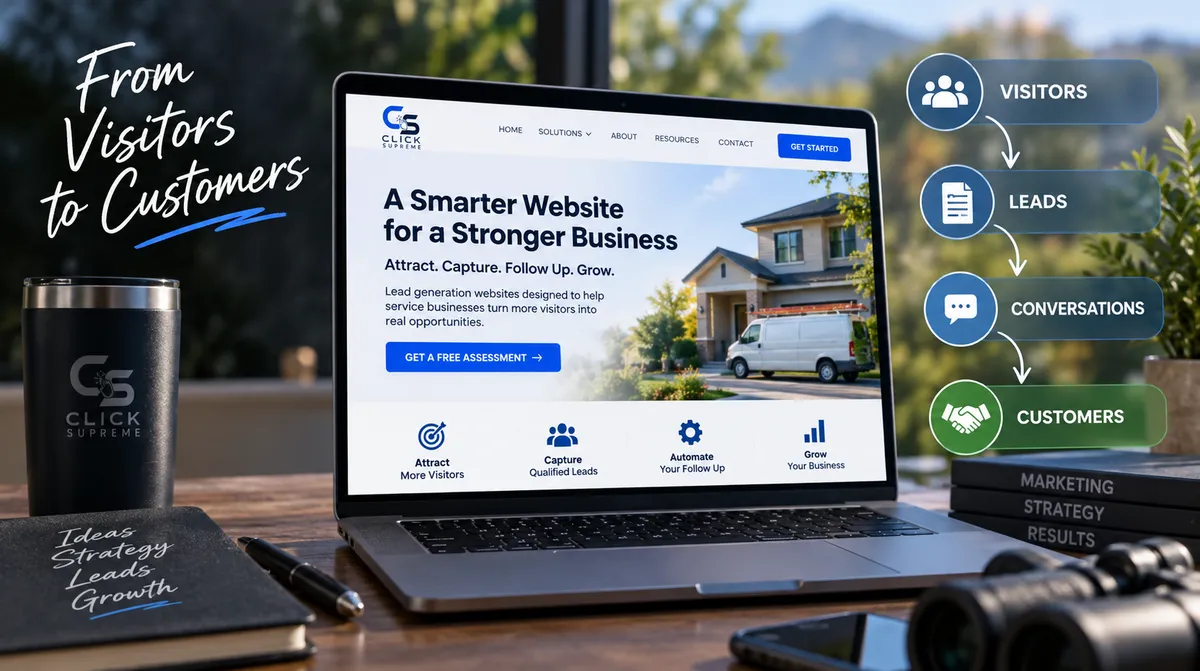
In its simplest form, the process looks like this:
Visitor → Lead → Conversation → Customer
A lead generation website is designed to make that progression easier.
How Does a Lead Generation Website Work?
A lead generation website usually sits in the middle of a larger marketing strategy.
First, you need to attract the right visitors. They might find the website through Google search, SEO, pay-per-click advertising, social media, referrals, direct mail, or another marketing channel.
Once someone arrives, the website has another job.
It needs to quickly help that person understand what the business offers, whether the service is relevant to them, why they should trust the company, and what they should do next.
This is where the structure of a lead generation website matters.
Instead of making visitors hunt through multiple pages for basic information, the website should guide them naturally through the decision-making process. The headline introduces the offer. The content explains the problem and solution. Testimonials, reviews, case studies, photographs, or other trust signals help establish credibility. Calls to action give the visitor a clear next step.
When someone takes that next step, their information can be captured and sent into the business's sales and follow-up process.
This is also where a lead gen website can become much more powerful than a standalone website.
When connected to a CRM and automation system, the website can help organize leads, trigger notifications, send confirmation messages, schedule appointments, and make sure new opportunities don't simply disappear after someone fills out a form.
What Should a Good Lead Gen Website Include?
There isn't one perfect lead generation website template that works for every company.
A website designed to generate roofing leads shouldn't necessarily look or sound like a website designed to attract big game hunters. The customer, service, price point, sales process, and questions people have before buying can all be different.
However, effective lead gen sites usually have several things in common.
The website clearly explains what the business does and who it serves. It focuses on the potential customer's needs rather than talking exclusively about the company. It provides enough information to build confidence without overwhelming the visitor. And most importantly, it makes the next step easy to understand.
This is why messaging matters just as much as design.
A visually impressive website can still perform poorly if someone lands on it and can't immediately figure out what the business offers.
One of the most important places to get that message right is at the very top of the page.
What Does Above the Fold Mean on a Website?
"Above the fold" refers to the portion of a webpage someone can see before they begin scrolling.
It's some of the most valuable space on a lead generation website because it creates the visitor's first impression.
When someone arrives from Google, an advertisement, a social media post, or another source, you only have a limited amount of time to reassure them that they've landed in the right place.
For most service businesses, the area above the fold should quickly communicate what you offer, who it's for, and what the visitor can do next.
That might include a clear headline, a short supporting statement, a relevant image, and a primary call to action.
The goal isn't to explain everything about your business in the first few inches of the page. It's to give someone enough information to keep going.
A visitor should be able to look at the page and think, "This is what I was looking for."
The rest of the website can then build on that initial interest.
Lead Generation Website vs. a Traditional Business Website
A traditional business website and a lead generation website can contain many of the same elements.
Both may have service pages, an About page, contact information, testimonials, photographs, reviews, and helpful articles.
The difference is less about individual features and more about how those features work together.
A traditional website may primarily focus on presenting information about the company. It explains who the company is, what it does, and how someone can get in touch.
A lead generation website takes that a step further by intentionally guiding visitors toward a conversion.
Imagine two websites for similar service businesses.
The first has professional photography, a company history, a list of services, and a phone number on the Contact page.
The second immediately explains the problem it solves, shows the visitor why the service is relevant, provides evidence that the business can deliver, answers common questions, and gives the visitor several natural opportunities to request more information.
Both websites may look professional.
But the second website has been intentionally designed around lead generation.
Lead Gen Website Examples for Service Businesses
Lead generation websites can be used across a wide range of industries, but they're particularly useful for service businesses where customers typically need to speak with someone before making a purchase.
HVAC companies, electricians, plumbers, roofers, contractors, landscapers, fishing charters, hunting outfitters, and professional service companies can all use the same basic concept.
The strategy, however, should be adapted to the customer.
An HVAC company's website might be designed around generating AC repair requests or replacement estimates. A roofing company may focus on inspection requests. A fishing charter might encourage visitors to inquire about dates and availability.
We've applied the same concept specifically to hunting outfitters in our guide to lead generation websites for hunting outfitters. In that situation, the goal isn't simply generating more website traffic. The website needs to help an outfitter attract prospective hunters, showcase hunting opportunities, build trust, and turn that interest into inquiries.
The industry changes, but the underlying principle stays the same.
A good lead generation website is designed around what the prospective customer needs to see before they're comfortable taking the next step.
Why Lead Generation Websites Work Well for Service Businesses
Service businesses have a unique advantage when it comes to lead generation websites because many of their sales begin with a conversation.
Someone replacing an HVAC system may have questions about equipment, pricing, financing, or installation.
A homeowner considering a new roof may want an inspection and estimate before making a decision.
A hunter considering a guided big game hunt may want to discuss available dates, accommodations, trophy expectations, travel logistics, and pricing.
In situations like these, asking the website to close the entire sale may be unrealistic.
But asking the website to start the conversation isn't.
That's why the real measurement of a service business website shouldn't simply be how many people visited it.
A more useful question is:
How many of the right people visited the website, and how many gave us an opportunity to continue the conversation?
Traffic Alone Doesn't Make a Website Successful
Getting more website traffic can be valuable, but traffic by itself doesn't necessarily produce revenue.
Imagine one business receives 1,000 website visitors this month and generates two inquiries.
Another business receives 300 visitors and generates 20 qualified inquiries.
Which website would you rather own?
This is why SEO, PPC advertising, and website conversion shouldn't be treated as completely separate strategies.
SEO can help your business appear when potential customers search for relevant information or services. PPC advertising can put your offer directly in front of people searching for a solution. Social media, referrals, and other campaigns can create additional sources of traffic.
But all of that traffic needs somewhere productive to go.
A lead generation website gives those visitors a destination that's specifically designed to turn interest into action.
Getting someone to click is only the beginning.
What happens after the click is what creates the opportunity.
What Happens After Someone Becomes a Lead?
This is an area where the website begins connecting with other parts of the business.
Someone can fill out a form and become a lead, but that doesn't automatically make them a customer.
The business still needs to respond.
Without a process in place, an inquiry may simply generate an email notification that sits in someone's inbox until they have time to deal with it. The longer that takes, the greater the chance that the prospect contacts another company.
A more complete lead generation system can send that information directly into a CRM.
From there, the business can immediately confirm the inquiry, notify the appropriate person, organize the prospect in the pipeline, schedule future follow-up, and use automation to help maintain communication.
The purpose of automation isn't to remove the human element from the sales process.
It's to make sure the human conversation doesn't get forgotten.
This becomes increasingly important as a business begins generating more opportunities.
Is Lead Generation Worth It?
Lead generation can be extremely valuable, but the answer depends on the economics of the individual business.
Not every lead has the same value.
Generating 100 people who have little intention of buying isn't necessarily better than generating 10 prospects who closely match your ideal customer.
This becomes particularly important for businesses selling higher-value services.
Instead of focusing only on the total number of leads, businesses should also pay attention to the quality of those leads, how many become conversations, how many conversations turn into customers, and what it costs to generate those opportunities.
The value of a lead generation website ultimately comes down to whether it helps create profitable customer relationships.
That's why the objective isn't simply "get more leads."
It's to attract the right people and give them a clear reason to raise their hand.
Do You Need a Completely New Website?
Not always.
Some businesses already have a solid website but aren't using it effectively for lead generation.
In those situations, improving the existing site may make more sense than starting over.
That could involve rewriting the above-the-fold messaging, creating stronger calls to action, improving service pages, adding dedicated landing pages, simplifying contact forms, adding stronger trust signals, improving mobile usability, or connecting the website to a CRM and follow-up system.
Other businesses may have websites that are outdated, difficult to navigate, poorly structured, or no longer representative of the services they offer. In those cases, a larger redesign may be worthwhile.
The important thing is not to redesign a website simply because it looks old.
Start with a better question:
Is the current website helping turn potential customers into qualified opportunities?
If the answer is no, figure out why before deciding what needs to be rebuilt.
A Lead Gen Website Is Only One Part of the System
One of the biggest mistakes a business can make is thinking that simply launching a new website will automatically generate leads.
The website is only one part of the system.
SEO helps potential customers find the business through organic search.
PPC advertising can generate targeted traffic more quickly.
The lead generation website gives those visitors somewhere to take action.
A CRM helps organize the opportunities that come in.
Automation helps maintain consistent follow-up.
Reputation Management helps provide the trust and social proof potential customers may need before making a decision.
These pieces become much more powerful when they're connected.
That's when a website stops functioning like an online brochure and starts becoming part of a customer acquisition system.
So, What Is a Lead Gen Website?
A lead gen website is a website intentionally designed to turn the right visitors into qualified opportunities for a business.
It attracts attention, communicates a clear offer, builds trust, creates a reason to take action, captures the lead, and connects that opportunity to a follow-up process.
For service businesses, that can completely change the role a website plays.
Instead of asking whether your business "has a website," the better question is whether that website is actively helping create new conversations.
At Click Supreme, that's how we approach lead generation websites.
We look at the website as one part of a larger system that can include SEO, PPC Advertising, CRM, Automation, and Reputation Management — all working together to help service businesses turn more of their marketing activity into real opportunities.
If you're interested in seeing how those pieces could work together for your business, take our Business Growth Assessment and tell us a little about where you are today.
We'll help you identify where the biggest opportunities may be and what could make sense as your next step.
