Mallard Bay Alternative for Hunting Outfitters: Is a Marketing-First Approach Right for You?
Hunting outfitters have more technology options than ever for managing their businesses, connecting with hunters, and booking trips. One name that has become increasingly visible in the outdoor industry is Mallard Bay, an established platform serving hunting and fishing outfitters.
If you have been searching for a Mallard Bay alternative, however, the first question may not be which platform has the longest feature list. A better question is: What problem are you actually trying to solve?
For some outfitters, the priority is managing bookings, payments, scheduling, clients, and other operational aspects of running an outfitting business. A platform such as Mallard Bay may make sense for those needs.
For other outfitters, the bigger challenge happens before the booking.
They need more hunters to find them. They need a website capable of turning traffic into inquiries. They need a system for capturing and organizing those leads, following up consistently, building trust, and ultimately converting more opportunities into booked hunts.
That is where a marketing-first approach like Click Supreme takes a different path.
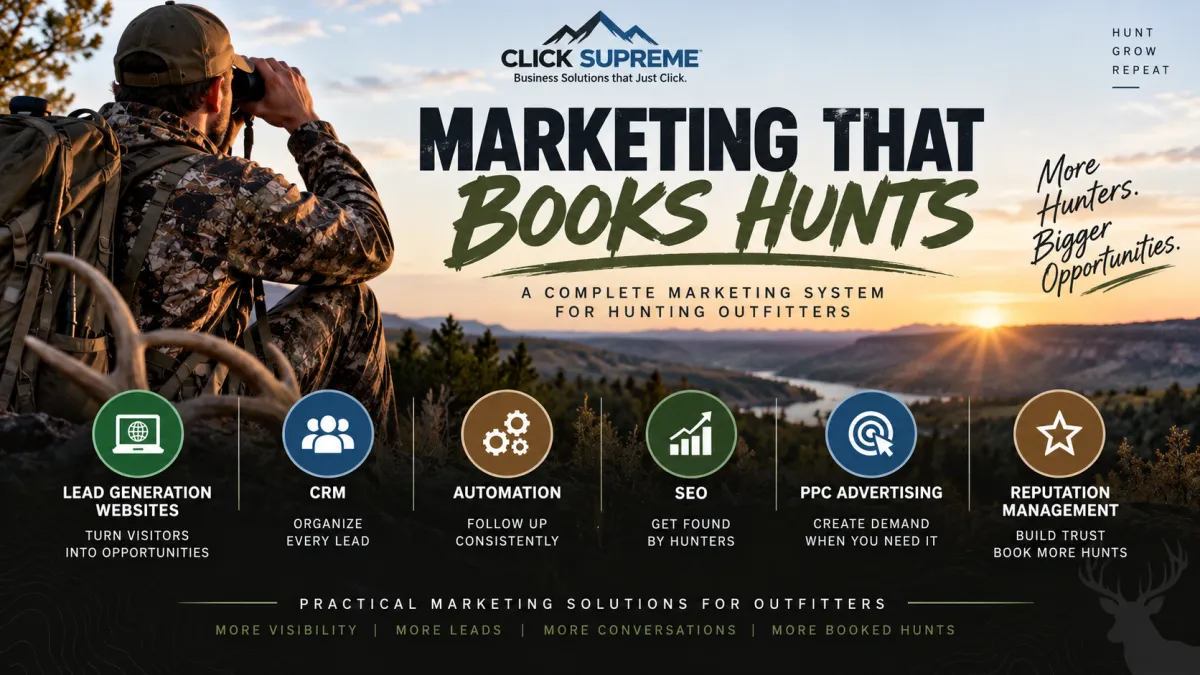
Rather than attempting to replace an outfitter-management or booking platform, Click Supreme focuses on six areas that can help hunting outfitters create a stronger customer-acquisition system: Lead Generation Websites, CRM, Automation, SEO, PPC Advertising, and Reputation Management.
For outfitters selling big-game hunts and other higher-value hunting experiences, improving that front end of the business can be especially important.
Why Outfitters Search for a Mallard Bay Alternative
Someone searching for a Mallard Bay alternative may have any number of reasons for doing so. They could be comparing costs, features, workflows, or simply researching what other options exist in the outdoor industry.
That does not necessarily mean Mallard Bay is the wrong solution.
Mallard Bay has built a platform around the hunting and fishing outfitter market. Outfitters interested in capabilities such as booking, payments, scheduling, and client management may find value in an industry-specific platform designed around those operational needs.
But not every outfitter begins with the same problem.
Imagine an outfitter offering trophy whitetail, elk, mule deer, aoudad, exotics, or other big-game opportunities. The outfitter may already know how to schedule hunts, collect payments, and take care of hunters once they book.
The real bottleneck may be getting enough qualified hunters into the pipeline in the first place.
That requires a different conversation.
Mallard Bay Outdoors, Mallard Bay Outfitters, and the Search for the Right Solution
Searches for terms such as Mallard Bay Outdoors and Mallard Bay Outfitters often point toward the same broader question: What technology should an outfitter use to help grow and manage the business?
There is an important distinction between managing demand and generating demand.
An outfitter-management platform can help organize what happens as hunters move toward and through the booking process. A marketing-first system concentrates primarily on creating opportunities, capturing those opportunities, and helping the outfitter convert them.
Those approaches are not necessarily competitors in the traditional sense. Depending on an outfitter's existing technology and needs, they may even address different parts of the customer journey.
That is why comparing solutions based only on features can miss the bigger picture.
Start by identifying the bottleneck.
If the problem is primarily booking administration and outfitter operations, investigate platforms built specifically around those functions.
If the problem is, "We need more qualified hunters finding us and more of those opportunities turning into conversations and booked hunts," a marketing-first approach deserves consideration.
Mallard Bay Approach vs. a Marketing-First Approach
At a high level, the difference comes down to the primary problem each approach is designed to address.
A platform such as Mallard Bay is oriented toward the hunting and fishing outfitter industry and can provide capabilities around areas such as booking, payments, scheduling, and client management.
A marketing-first approach begins farther up the funnel.
It asks questions such as:
Are enough prospective hunters discovering your business?
Does your website give those hunters a clear reason to contact you?
Are inquiries being captured in one place?
What happens when a hunter submits a form but is not ready to book immediately?
Can you consistently follow up without manually remembering every conversation?
Are you visible when hunters search Google for the types of hunts you offer?
Can you use paid advertising to generate opportunities during the periods when you need them?
Do your reviews and online reputation give a prospective hunter enough confidence to take the next step?
These are the problems Click Supreme is designed to help address.
The goal is not to become another outfitter-management platform. It is to help outfitters build the marketing infrastructure surrounding the process of attracting and converting hunters.
That strategy is built around six pillars.
1. Lead Generation Websites: Turning Website Traffic Into Hunting Opportunities
A hunting outfitter's website should do more than display beautiful photographs of successful hunts.
Those photographs matter. So do information about the property, guides, lodging, species, hunting methods, pricing, and experience. But ultimately, a prospective hunter needs an obvious next step.
That is where a lead generation website differs from a basic brochure-style website.
The site should be structured around the questions prospective hunters are already asking and the actions you want them to take. Someone researching a trophy whitetail hunt may be at a very different stage than someone ready to discuss available dates.
A marketing-first website creates pathways for both.
That could mean dedicated pages for specific species or hunting opportunities, strategically placed calls to action, simple inquiry forms, mobile-friendly layouts, and clear messaging around what makes the outfitter different.
For higher-value hunts, the website does not necessarily need to close the entire sale.
It needs to start the right conversation.
2. CRM: Creating a Pipeline for Prospective Hunters
Generating leads creates another problem: keeping track of them.
A hunter may inquire today and book tomorrow. Another may be planning a hunt six months or a year in advance. Someone else may be coordinating a corporate hunting retreat or researching a trip for a group.
Treating every inquiry the same can leave opportunities behind.
A CRM for hunting outfitters provides a central place to organize those conversations and understand where each prospective hunter stands.
Instead of relying on scattered emails, text messages, handwritten notes, and memory, an outfitter can create a visible pipeline.
A simple pipeline might include stages such as new inquiry, contacted, qualified, considering dates, deposit pending, booked, and past client.
The exact stages should match the outfitter's sales process.
The important part is knowing who is in the pipeline, what they are interested in, and what needs to happen next.
3. Automation: Following Up Without Losing the Personal Touch
Automation is not about replacing the personal relationship between an outfitter and a hunter.
For higher-value hunting experiences, that relationship can be one of the most important parts of the sale.
Automation should support it.
Consider what happens after a prospective hunter submits an inquiry on Saturday evening while everyone is busy with clients. A simple automated response can immediately confirm that the inquiry was received and explain what happens next.
From there, automation can help with reminders, nurture messages, appointment confirmations, re-engagement, and other repetitive communication.
The outfitter can still personally call the prospect, answer detailed questions, discuss the hunt, and build the relationship.
The technology simply helps prevent opportunities from disappearing because nobody remembered to follow up.
For outfitters receiving inquiries from multiple channels, connecting the website, CRM, and automation can create a much more consistent process from first contact to booked hunt.
4. SEO: Getting Found by Hunters Already Searching
Some of the best opportunities are hunters already searching for exactly what an outfitter sells.
That is where search engine optimization becomes valuable.
Rather than trying to rank a website for every hunting-related term imaginable, an outfitter can build content around the specific hunts, species, locations, and questions most relevant to the business.
For example, someone searching for information about trophy whitetail hunts has demonstrated very different intent than someone casually browsing hunting photos on social media.
SEO creates an opportunity to meet that hunter during the research process.
Individual hunt pages can target commercial searches, while educational articles can answer questions hunters ask before making a decision. Over time, those pages can create multiple entry points into the website.
For big-game outfitters, that organic visibility can become particularly valuable because a single qualified hunter may represent a significant booking.
The objective is not simply more website traffic.
It is more of the right traffic.
5. PPC Advertising: Creating Demand When You Need It
SEO is a long-term strategy. Paid advertising can provide a more immediate way to put an offer in front of prospective hunters.
With PPC advertising, outfitters can build campaigns around specific hunting opportunities rather than simply advertising the business as a whole.
An outfitter looking to fill remaining dates for a particular hunt, for example, could build a dedicated landing page and advertising campaign around that opportunity.
The same concept can be applied to different species, seasons, packages, or geographic markets.
The advantage of a marketing-first system is what happens after someone clicks.
Instead of paying for traffic and hoping the visitor calls, the landing page can capture the opportunity, send it into the CRM, trigger appropriate follow-up, and give the outfitter a clear process for continuing the conversation.
That connection between advertising and follow-up is critical.
Traffic alone does not book hunts. The entire conversion path matters.
6. Reputation Management: Building Trust Before the First Conversation
Hunters considering a significant trip are unlikely to evaluate an outfitter based on a single advertisement.
They research.
They look at websites, photographs, social profiles, Google results, testimonials, and reviews. They want to know whether previous clients had the experience they are hoping to have.
That makes reputation management part of the marketing system.
A strong review process helps outfitters consistently request feedback from satisfied clients rather than leaving reputation growth entirely to chance.
It can also help create a growing body of social proof that prospective hunters encounter while researching the business.
This becomes even more important as the value of the hunt increases.
Someone considering a major big-game hunting trip may be investing thousands of dollars, taking time away from work, traveling a significant distance, and potentially planning months in advance.
Trust matters.
A strong reputation will not replace good marketing, but it can make every other marketing channel more effective.
How the Six Pillars Work Together
The real advantage of a marketing-first approach appears when these six pieces stop operating independently.
SEO and PPC can generate traffic.
The lead generation website can convert some of that traffic into inquiries.
The CRM can organize those inquiries.
Automation can help ensure they receive timely communication.
Personal sales conversations can move qualified hunters toward booking.
Reputation management can strengthen the trust surrounding the entire process.
That creates a connected customer-acquisition system rather than a collection of unrelated marketing tools.
For an outfitter, the journey could look something like this:
A hunter searches for a specific big-game opportunity and discovers an outfitter through Google. The hunter visits a dedicated page explaining the hunt, property, experience, and next steps. They submit an inquiry.
That inquiry enters the CRM automatically.
The hunter receives an immediate confirmation while the outfitter is notified of the new opportunity. The outfitter follows up personally, answers questions, discusses dates and expectations, and moves the prospect through the sales process.
If the hunter is not ready today, the opportunity does not have to disappear.
That is the system Click Supreme is interested in building.
Which Approach Is Right for Your Outfitting Business?
If you are researching a Mallard Bay alternative, avoid starting with the assumption that one solution needs to replace another.
Start with the business problem.
If your biggest challenge is managing bookings, payments, scheduling, clients, and other operational components of running an outfitting business, an industry-specific platform such as Mallard Bay may be worth evaluating.
If your biggest challenge is generating more qualified opportunities and converting more of those opportunities into booked hunts, a marketing-first strategy may deserve more attention.
Ask yourself:
Do enough prospective hunters find us online?
Does our website consistently generate inquiries?
Do we know where every new lead goes?
Do we have a reliable follow-up process?
Are we visible for the hunts we most want to sell?
Can we intentionally generate opportunities through advertising?
Does our online reputation reinforce the quality of the experience we provide?
If several of those questions expose gaps, the issue may not be your booking platform.
It may be your marketing infrastructure.
A Different Kind of Mallard Bay Alternative
Click Supreme is not attempting to recreate Mallard Bay.
The distinction is intentional.
Mallard Bay serves the outdoor industry with technology geared toward hunting and fishing outfitters. For businesses looking for those management and booking capabilities, that approach may be a strong fit.
Click Supreme approaches the outfitter market from the marketing side.
We are interested in what happens before the booking: how hunters discover you, what they see when they arrive, how their information is captured, how quickly they receive a response, how consistently the relationship is nurtured, and how your reputation supports their decision.
Our six pillars — Lead Generation Websites, CRM, Automation, SEO, PPC Advertising, and Reputation Management — are designed around that customer-acquisition journey.
For outfitters selling big-game hunts and other higher-value experiences, even a relatively small improvement in that process can create meaningful opportunities.
The question is not simply whether you need a Mallard Bay alternative.
The better question is:
Where is your outfitting business actually losing opportunities?
If hunters are already finding you and your primary need is managing what happens after they decide to book, explore technology built around those operational needs.
But if you need more of the right hunters discovering your business, entering your pipeline, receiving consistent follow-up, and ultimately becoming booked clients, it may be time to look at the problem from a marketing-first perspective.
That is the side of the outfitting business Click Supreme is built to help improve.
Ready to Find the Gaps in Your Outfitter Marketing?
If your biggest challenge is generating more qualified hunting opportunities — or you are not sure where prospects may be falling through the cracks — start with the Click Supreme Outfitter Growth Assessment.
The assessment is designed to take a closer look at how your outfitting business currently attracts, captures, follows up with, and converts prospective hunters across our six core areas: Lead Generation Websites, CRM, Automation, SEO, PPC Advertising, and Reputation Management.
Take the Click Supreme Outfitter Growth Assessment:
https://clicksupreme.com/outfitter-assessment
