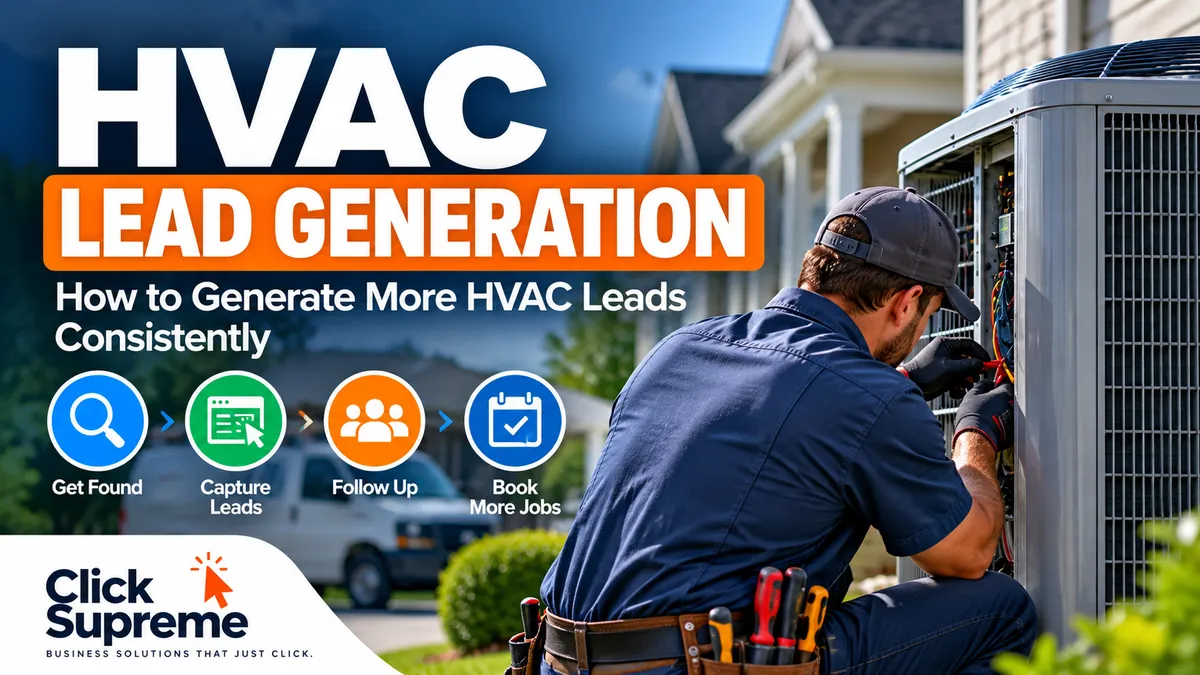
HVAC Lead Generation: How to Generate More HVAC Leads
For an HVAC company, generating more leads isn't simply about getting more people to visit your website. The real goal is to consistently turn local homeowners and businesses who need heating and cooling services into calls, form submissions, appointments, and ultimately paying customers.
That's what makes HVAC lead generation different from simply advertising your business. A strong lead generation system connects several pieces together — visibility, a website built to convert, fast response times, organized follow-up, and a process for staying in front of prospects who aren't ready to book immediately.
When those pieces work together, your business isn't relying on a single source of leads. You're building a system that can capture demand from Google, paid advertising, referrals, reviews, and other marketing channels while giving your team a process for turning more of those opportunities into booked jobs.
What Is HVAC Lead Generation?
HVAC lead generation is the process of attracting potential customers who need heating, cooling, installation, maintenance, or repair services and giving them a clear way to contact your business.
A lead might be someone whose air conditioner stopped working and needs immediate service. It could also be a homeowner researching a new HVAC system, a property owner comparing estimates, or an existing customer who will need seasonal maintenance in the future.
Because these customers are at different stages of the buying process, effective lead generation for HVAC companies goes beyond generating a phone call. Your marketing should make it easy for prospects to find your company, understand what you offer, contact you, and continue hearing from you if they don't schedule immediately.
That's where having an actual lead generation system becomes important.
How Does HVAC Lead Generation Work?
A simple HVAC lead generation system can be thought of as a connected process:
Traffic → Website → Lead Capture → Fast Response → Follow-Up → Appointment → Customer → Review
Traffic may come from Google search, your Google Business Profile, PPC advertising, social media, referrals, or another marketing channel. Those prospects then need somewhere to go where they can quickly understand your services and take the next step.
Once someone calls or submits a form, the marketing process shouldn't stop. Their information needs to be captured, your company needs to respond quickly, and the prospect may need additional follow-up before an appointment is scheduled.
After the work is completed, satisfied customers can be asked for reviews. Those reviews can strengthen your online reputation and help future prospects feel more comfortable choosing your company.
Instead of treating each marketing activity separately, the goal is to make all of these pieces support one another.
1. Build an HVAC Website Designed to Generate Leads
Many HVAC websites function primarily as online brochures. They explain the company, list services, provide a phone number, and perhaps include a contact form. That's useful, but a website can do considerably more.
A lead generation website is designed around getting visitors to take a specific next step. For an HVAC company, that could mean calling for service, requesting an estimate, scheduling an appointment, or submitting information about the problem they're experiencing.
Each important service should have a clear path toward conversion. Someone searching for AC repair shouldn't have to dig through several pages to figure out whether you provide the service or how to contact you.
Clear headlines, prominent calls to action, service-area information, reviews, trust signals, mobile-friendly design, and simple forms can all help reduce friction between arriving on your website and contacting your company.
If you'd like to understand this concept in more detail, read our guide on what a lead generation website is.
2. Use Local SEO to Capture Existing HVAC Demand
Some of the best HVAC prospects are already searching for exactly what your company provides.
Searches for AC repair, HVAC installation, furnace repair, HVAC maintenance, and similar services can represent strong buying intent. Local SEO helps position your business where those potential customers are already looking.
That includes optimizing your website around the services you actually provide, developing useful service and location content, maintaining an accurate Google Business Profile, and building a strong collection of customer reviews.
SEO generally isn't an overnight lead-generation strategy. It takes time to build visibility, especially in competitive markets. However, the long-term benefit is that your website can become an asset that continues attracting prospective customers without paying for every individual click.
We've covered this in greater detail in our article, Is SEO Worth It for Service Businesses.
3. Use PPC Advertising to Generate HVAC Leads Faster
While SEO can help build long-term visibility, pay-per-click advertising can put an HVAC company in front of prospective customers much faster.
Google Ads can be particularly useful because you can target searches from people actively looking for HVAC services. Instead of waiting for someone to discover your company, you can advertise directly against searches that indicate a potential need for service.
The downside is that HVAC advertising can be competitive and expensive. Paying for traffic only makes sense if your website, lead capture process, and follow-up system are capable of turning enough of that traffic into customers.
This is why PPC shouldn't be viewed in isolation. Sending expensive traffic to a poorly designed page or failing to respond quickly to inquiries can make an otherwise promising advertising campaign unprofitable.
For a deeper look at the economics behind paid search, see How Much Does PPC Management Cost.
4. Respond to New HVAC Leads Quickly
Generating a lead is only the beginning.
HVAC customers often contact a company because they have a problem that needs to be solved. If an air conditioner stops working during a hot afternoon or a heating system fails during cold weather, that customer may contact several companies until someone responds.
That makes response time an important part of lead generation.
Automation can help bridge the gap between an inquiry and a personal response from your team. For example, when someone submits a website form, an immediate confirmation can let them know their request was received. If someone calls and nobody is available to answer, a missed-call text can provide another opportunity to start the conversation.
Automation doesn't need to replace human communication. Used properly, it helps make sure potential customers aren't forgotten while your team is working in the field, handling another customer, or dealing with a busy service schedule.
You can learn more about how this works in our guide to lead automation.
5. Keep HVAC Leads Organized With a CRM
As lead volume increases, relying on memory, handwritten notes, email inboxes, or scattered spreadsheets becomes increasingly difficult.
A customer relationship management system, or CRM, gives your business a central place to keep track of leads and customer conversations. Instead of simply knowing that someone called, you can see where that person is in your sales process and what needs to happen next.
This becomes especially valuable for opportunities that aren't closed on the first conversation. A homeowner considering a complete HVAC replacement may request several estimates before making a decision. Another customer may postpone a repair or installation until a later date.
Those leads still have value.
A CRM gives your company a way to organize those opportunities and create a repeatable follow-up process rather than allowing them to disappear once the initial conversation ends.
For more information, read CRM for Service Businesses.
6. Follow Up With HVAC Leads That Don't Book Immediately
Not every HVAC lead is going to schedule service during the first conversation.
Some prospects are comparing companies. Others are waiting for an insurance decision, discussing a major purchase with a spouse, checking financing options, or simply aren't ready to move forward yet.
That doesn't necessarily mean the lead is lost.
A structured follow-up process allows your company to stay in contact without requiring someone to manually remember every prospect. Depending on the type of inquiry, follow-up could include a combination of phone calls, email, text messages, reminders, or longer-term nurturing.
This is also where the economics of lead generation become important. If your company paid to generate a prospect through PPC or another advertising channel, giving up after one attempt means potentially leaving part of that advertising investment on the table.
Sometimes generating more revenue doesn't require dramatically increasing the number of leads coming into the business. It requires doing a better job with the leads you already have.
7. Turn Completed HVAC Jobs Into More Reviews
The lead generation process doesn't have to end when the job is complete.
Satisfied customers can become an important source of future business through reviews, referrals, repeat service, and maintenance work. One of the simplest ways to capitalize on that opportunity is to consistently ask customers for feedback after a completed job.
The problem is that review requests are easy to forget when technicians and office staff are busy.
An automated review request process can help make asking for reviews part of the normal customer journey. Instead of depending entirely on someone remembering to send a request, your system can trigger the appropriate message after a completed service.
Over time, those reviews can strengthen the company's reputation and provide additional trust for prospects researching HVAC companies online.
We've explained the process further in Automated Review Requests: How to Get More Customer Reviews.
Buying HVAC Leads vs. Building Your Own Lead Generation System
HVAC companies have another option: buying leads from third-party lead generation companies.
Purchased leads can provide opportunities without requiring your company to build every marketing channel from scratch. Depending on the provider, those leads may be exclusive to one contractor or shared among several companies.
The tradeoff is that your company remains dependent on another business for the flow and cost of those leads.
Building your own HVAC lead generation system requires more work upfront, but it can create marketing assets that your company controls. Your website, Google visibility, customer database, reviews, CRM, follow-up processes, and past customer relationships all remain part of your business.
The two approaches don't necessarily have to be mutually exclusive. An HVAC company can purchase leads while simultaneously developing its own marketing channels. The important thing is understanding what each lead costs, where it came from, and how many of those opportunities ultimately become profitable customers.
The Best HVAC Lead Generation Strategy Connects Everything Together
It's easy to look for one marketing channel that will solve an HVAC company's lead generation problems.
In practice, the strongest system usually involves several pieces working together.
SEO and Google Business Profile optimization can help customers discover your business organically. PPC can generate additional demand when you want to reach more prospects. A lead generation website gives those visitors somewhere to convert. A CRM keeps opportunities organized, while automation and follow-up help prevent valuable leads from slipping through the cracks.
Finally, completed jobs create opportunities for reviews, referrals, repeat business, and future maintenance work.
That creates a cycle:
Get Found → Generate Lead → Respond → Follow Up → Book Job → Deliver Service → Generate Review → Get Found Again
The goal isn't simply to generate the largest possible number of HVAC leads. It's to build a system that helps your company consistently turn more of the opportunities you generate into customers.
Ready to Improve Your Lead Generation System?
If you're generating leads but aren't sure where opportunities may be slipping through the cracks, Click Supreme's Business Growth Assessment can help you take a closer look at your current marketing and follow-up process.
The assessment looks at areas such as your website, lead generation, customer follow-up, automation, online visibility, and reputation management to help identify potential opportunities for improvement.
